
Turbo Soccer Kickoff Guide
A repeatable Turbo Soccer kickoff: boost straight at the center sphere with the car grounded, then make the right first-touch call — shoot, take the 50/50, or rotate back.
Every Turbo Soccer match — and every restart after a goal — begins with a kickoff, and the reliable version is short enough to memorize: play is held until the kickoff whistle sounds, then you drive straight at the center sphere using boost with all four wheels on the ground. If both cars reach the ball at the same moment, the first contact resolves as a 50/50 collision. What makes kickoffs feel unpredictable is everything in the two seconds after that touch, so this guide covers both halves: the opening challenge and the recovery.
How a kickoff starts
You don't need to memorize spawn layouts or stopwatch timings to open well, because the documented sequence keys off sound, not frames:
- Wait for the whistle. Play is frozen until it sounds. In recorded matches you can hear a short countdown — a "3, 2, 1" count — immediately before the restart, so use it as your cue to focus, not as a trigger to move early.
- Find the center sphere. The opening ball always sits at midfield between the two teams; that sphere is your target.
- Go at the whistle. Kickoffs recur after every goal, so you'll get many reps per match to make the routine automatic.
The straight kickoff, step by step
This is the sequence three separate guides describe identically, which makes it the default opening to trust:
- At the whistle, drive straight toward the center sphere using boost.
- Stay grounded into the hit — all four wheels on the floor as you make contact. A grounded car doesn't get launched out of position or off-target by the collision; an airborne one does.
- Read the contact. If the opponent arrives at the same instant, expect a 50/50: the ball squirts somewhere, and the next move matters more than the collision itself.
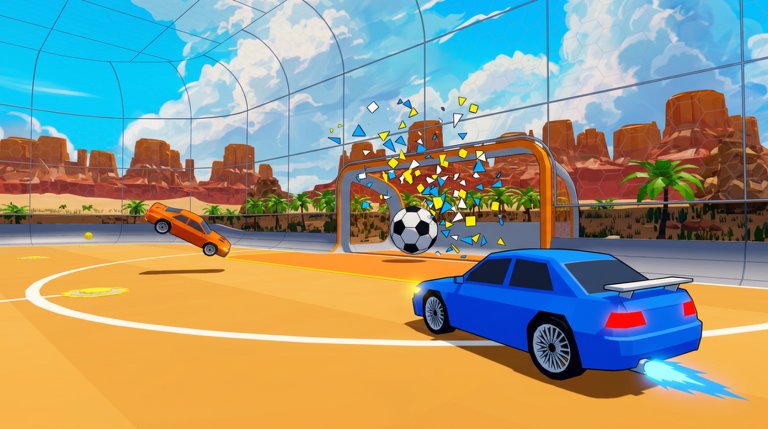
The first-touch decision
The kickoff doesn't end at contact — it ends with your choice. If your touch wins the ball, play it with purpose and then pick one of two documented options: shoot, or take a soft 50/50 rather than slamming into a lost cause. What you avoid is touching the ball randomly and letting the rebound decide for you. For converting a clean opening touch, see the shooting tips page.
If you lose the kickoff, rotate back
Here's the mindset that prevents most kickoff goals against: losing the kickoff by itself is fine. Losing the kickoff and double-committing is how sudden deficits appear.
The repeatable recovery has two rules:
- Retreat immediately after your touch. In one recorded ranked session, a player who was beaten on the kickoff rotated straight back instead of chasing — and treated it as the normal response, not an emergency.
- Never double-commit. Avoid sending two players at the same ball, so at least one teammate is always free to guard the goal line against counterattacks.
In team modes, those jobs are assigned by position:
| Role | Kickoff job |
|---|---|
| First man | Boost straight, touch with purpose, then either shoot or take a soft 50/50. |
| Second man | Sit boost-ready for the bounce; do not mirror the first challenge. |
| Third man (3v3 only) | Shadow near the midfield pad and watch for back-door demos. |
The second man's rule is the one most players break: sitting ready for the rebound feels passive, but mirroring the first challenge is exactly the double-commit that turns a lost kickoff into a conceded goal.
The 1v1 kickoff
1v1 Duels is described as intense individual matchups focused on kickoff control and defensive recovery — in other words, the opening challenge is the defining contest of the mode. There is no separate documented 1v1 kickoff technique to learn: you execute the same straight, grounded kickoff, and because there are no teammates, a lost challenge means you rotate back and defend, which is precisely the defensive recovery the mode emphasizes. Expect opponents at higher ranks to vary their rhythm too — in that same ranked session, opponents repeatedly faked the kickoff rather than hitting the ball. Fakes are something to recognize and stay balanced against, not a technique with published steps. For the full duel plan beyond the opening touch, see the 1v1 guide.
A two-minute kickoff practice routine
Two named styles — the diagonal cheat and the shadow kickoff — appear in the game's recommended technique lists, but the straight kickoff above is the one with complete, verifiable instructions, so build on it first. The fastest way to make it automatic is a short drill block called Kickoff reps (2 minutes):
- Five straight kickoffs with early touch — whistle, boost, grounded contact, deliberate touch.
- Five lose-and-rotate simulations — take the touch, then immediately retreat, exactly as you would after being beaten.
The second set matters as much as the first: retreating after a lost kickoff is drilled as a rehearsed simulation, not improvised in the moment. Run the routine in free play or before ranked sessions — the training guide has more drills to stack onto it — and then take the sequence into your next ranked matches.
Related Guides
Training Guide: Practice Routine
An ordered practice routine built from real drills, from Free Play contacts to Rings, Targets, and ranked-readiness checks.
Shooting and Goal Scoring Tips
Line up behind the ball, finish ground shots at the far post, and know exactly when a goal counts.
Ranked Mode: Entry and Match Rules
Learn the level gate to queue Ranked, plus the formats, HUD rules, and standings that set it apart.
1v1 Guide
Enter the 1v1 queue and learn the solo decisions that matter: wait-first kickoffs, patient challenges, and recovery.